INTERVIEW – CECILIA LASCIALFARI “ARTIFICIAL INTELLIGENCE: IF YOU COPY MY ART YOU MENTION MY NAME” – November 6, 2023
Questions:
1) You are an artist. Why did you approach the world of new technologies? Can you tell us your story?
2) How did you first become interested in the technology sector?
3) You have a full time job but you even know you have a creative side. Why do you work over so many different projects?
4) Can artificial intelligence be called “Art” or should we not call it “Art”?5) In one of your last speeches you stated that “Technology has declared that it does not need creatives”. Can you explain this statement better?
6) Do you think art history can help us understand new technologies and especially AI?
7) You wrote 13 concepts for generative creativity. Can you tell us about these 13 concepts?
8) Where are we with the copyright of images created by AI?
9) You said that “If AI is male, we must teach men what an abortion means. Feminine world can point the right way to an AI creation ethics” Can you explain better what you mean?
10) Conclusion
1) You are an artist. Why did you approach the world of new technologies? Can you tell us your story?
I’M AN ARTIST. My name is Cecilia Lascialfari and I’m a Creative Strategist Technologist. I’m a researcher in the fields of Artificial Intelligence, Augmented and Virtual Reality, I’m a Videomaker, a Photographer, a Prompt Creator. I’m an International Journalist and finally I’m a Community Manager and XR Consultant for Italy.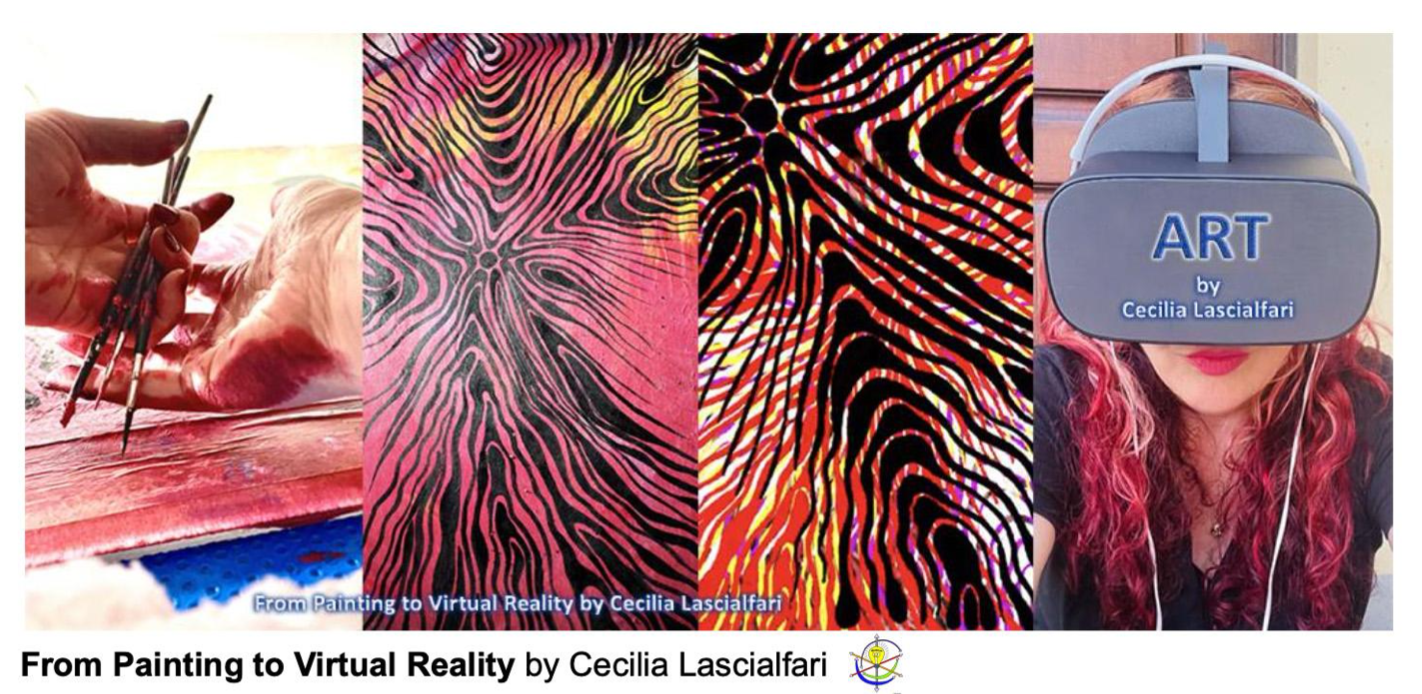 I graduated with a thesis on Contemporary African Art at the Academy of Fine Arts in Florence, and I specialized in video at RAI (Italian Radio and Television), with a Masters in Multimedia Content Design organized by the Faculty of Engineering of the University of Florence.
During my years of study at the Academy of Fine Arts in Florence, I learned to draw naked bodies and still lifes. I painted pictures. I worked the clay. I made engravings on zinc tablets, learned to use the lathe, I studied the history of art, anatomy and photography. I learned to be a good Photographer. I used 3D and graphics software. I learned how to make videos and animate drawings. I got to know Digital Art, Augmented Reality and Virtual Reality. And I’ve always looked for new tools to improve my creativity. 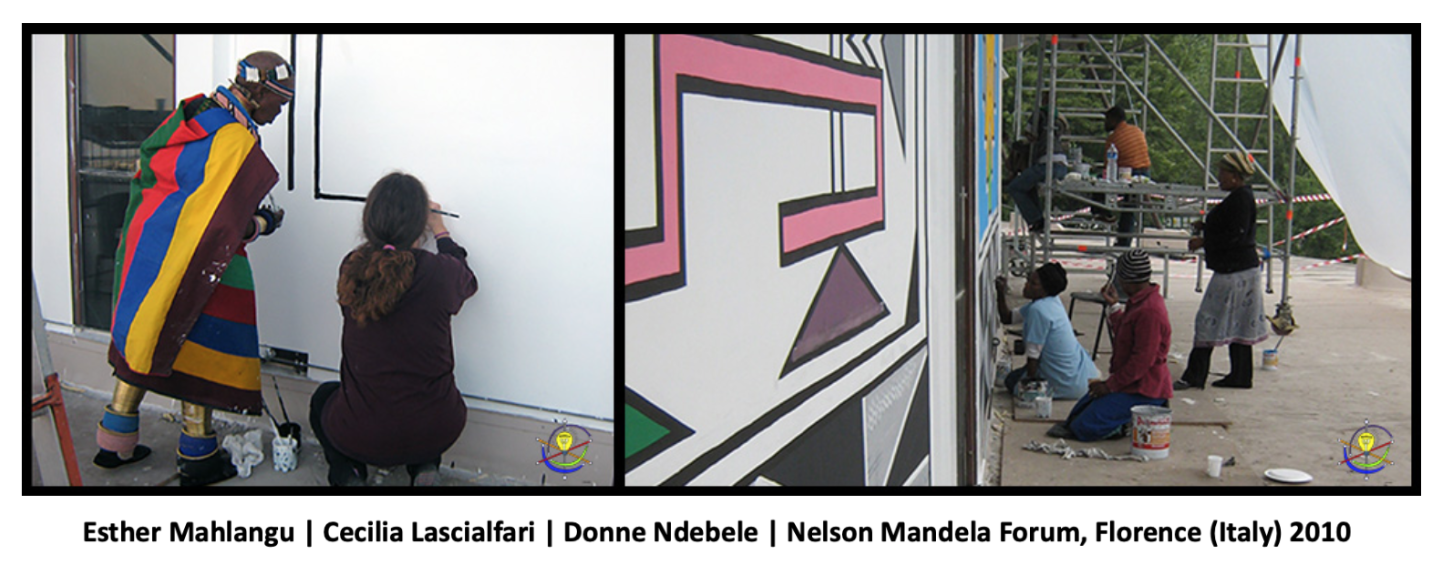 In 2005 I have projected the pictorial installation of the Nelson Mandela Forum in Florence, curated by the international artist Esther Mahlangu and the Ndebele Women (South Africa); project carried out by the Palasport Association, together with the Municipality of Florence and the Nelson Mandela Foundation in September 2010.
Since 2011, I have been working in the Digital Innovation Department of the third Italian publishing group in the field of multimedia productions, and I manage the implementation of projects that exploit new technologies such as Augmented and Virtual Reality, 360° degree video, NFC (Near Field Communication), Artificial Intelligence. I also deal with the production of audio books and new ways of interacting with digital books.I have in-depth knowledge of web marketing, social media and website management. Meanwhile, I realized that the world of technology had moved forward very quickly in terms of technological solutions, and it needed creative figures.Programmers, engineers and software specialists were no longer enough…This world needed new ideas and artists. The most difficult thing was matching two such different worlds, one that fights to break the rules and the other based on the rules! In 2019 I started trying to understand the XR world.And for 4 years I have just watched what was happening waiting for my moment to come.
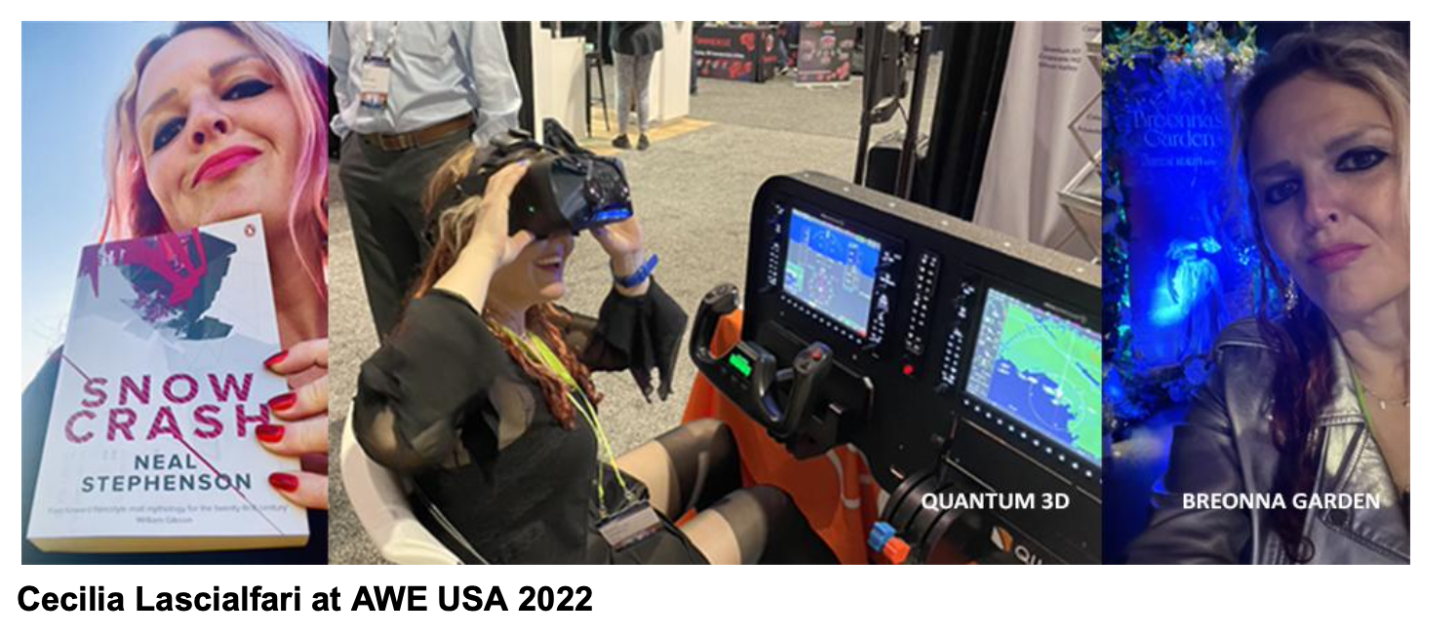 In March 2020, during the period of the Covid pandemic, I opened the online journal of ARea6DoF.com and specialized in the field of innovative technologies (AI/AR/VR/XR). I joined the AWE community and starting from January 2021, I organized the “AWE Nite Florence” in a team with Antony Vitillo. The AWE Nite are online meetings that allow Italian and foreign companies dealing with new technologies to present themselves to an international community of professionals in the XR sector. Following trips to Silicon Valley in California, I also joined the GatherVerse Community, with Christopher Lafayette, who is based in San Francisco, and became an international speaker.
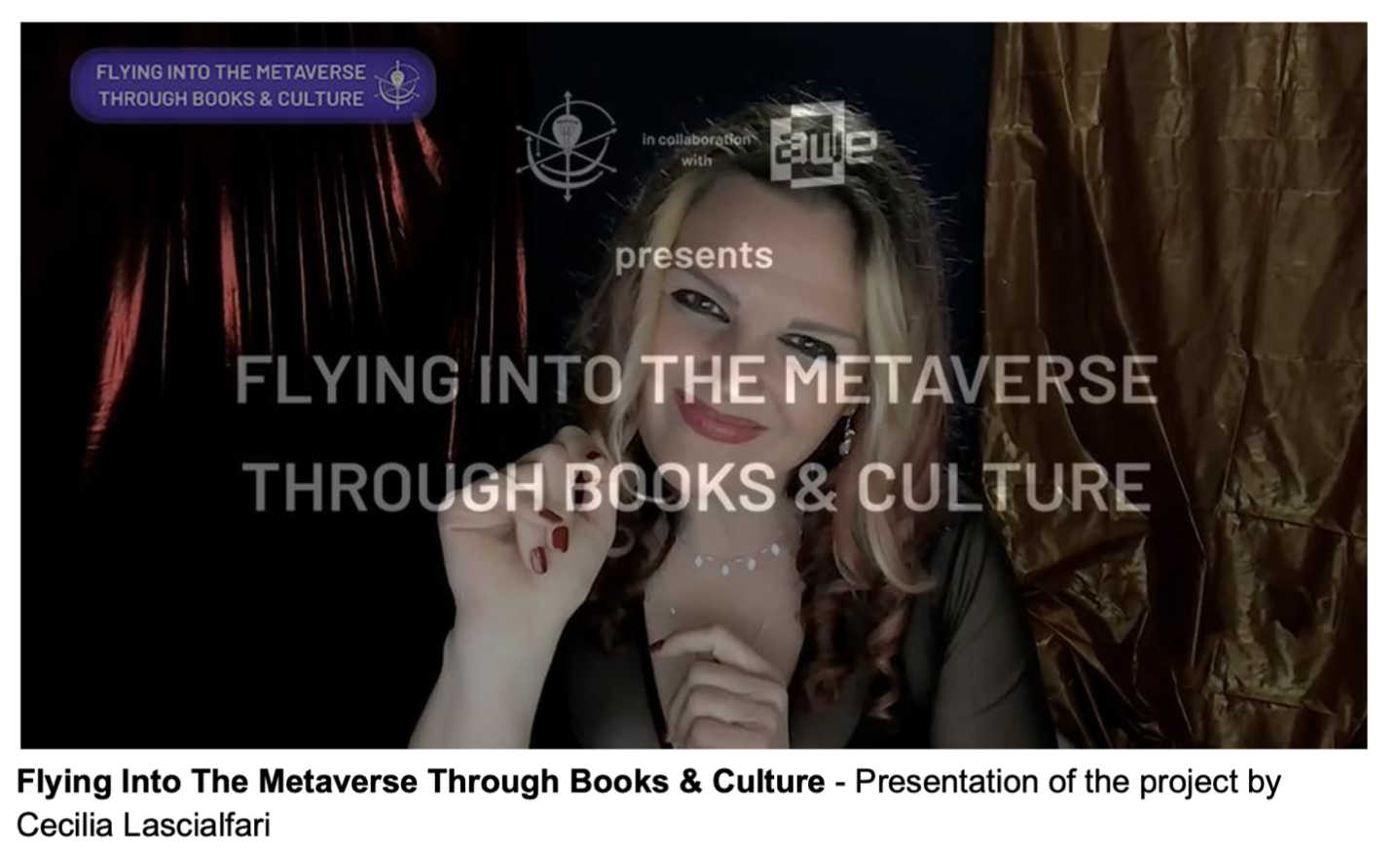
I created the “Flying Into The Metaverse Through Books & Culture” project supported by the two communities of AWE and GatherVerse, with the aim to connect the world of culture with that of technology and I interviewed some of the top international experts, who have published books on the XR world.
I am a contributor photographer to Getty Image and Istock, and thanks to my artistic background, in recent months I have become a reference figure for research on the rights of images generated by Artificial Intelligence software and I created the research group “Future of Creativity in the XR World”, where professionals from all over the world contribute and study the AI sector with the aim of understanding how the future of Art and Creativity will evolve, while also analyzing the other AI sectors at the same time.
In recent times, Artificial Intelligence has involved us in a truly overwhelming series of discussions, which have attracted the interest of most of the audience that deal with the new technologies and beyond.
2) How did you first become interested in the technology sector?
My first experience related to the world of immersive technologies was dated September 2018, when I decided to step out of my comfort zone, follow my instincts and take risks, taking my son who was only 11 years old to see the Ars Electronica Festival in Linz, Austria, one of the most innovative exhibitions in Europe, combining Art, Electronics, Music, Artificial Intelligence, New Technologies. It was a wonderful experience.
In October 2019 I went to Munich to participate in a big EXPO called “AWE EU” on new technologies.
I have always looked at Virtual Reality with distrust, because I consider it cold compared to the painting techniques I had learned at the Academy of Fine Arts. But I was curious to meet this world and Munich was a perfect opportunity.
I introduced myself to AWE EU Munich as a journalist’s apprentice. At the time I was writing and making videos for a small provincial newspaper with an attempt to enroll in the register of Italian journalists. AWE EU was a truly exciting experience. The approach with all these new technologies, the difficulty of the English language, the events that followed one after the other, and the possibility that the organization of AWE gave me when I told them that I would have my son with me (because I was alone and I could not leave him at home) made me understand that perhaps that was the right way to follow.
The most particular anecdote of that experience was the interview with Ori Inbar.
I hadn’t prepared anything and all of a sudden a spokesperson came to the press office announcing that Ori would soon be available for interviews.
I prepared 5 questions at the speed of light, in terrible English, aided by Google Translate, and almost holding my breath, I took courage and put myself in the shoes of a real established journalist. At the end of the interview Ori asked me where I would publish that interview and when I told him that it would go to a provincial newspaper, he was a bit surprised and gave me two tips: he wanted me to write in a technology newspaper and that his video was dubbed in Italian and subtitled in Italian.
You can see the interview with Ori Inbar from 2019 at this link: Realtà Aumentata e Virtuale: Cecilia Lascialfari intervista Ori Inbar durante l’AWE 2019 (Italian Version).
A few months later, on LinkedIn, I met Christopher Lafayette who had opened a call to action inviting people to write an article on his website Immersive Directory. And that was the first time when I wrote an article matching culture and technology.
Four years later I realized what Ori Inbar had suggested to me in 2019, and I immediately opened ARea6DoF.
3) You have a full time job but you even know you have a creative side. Why do you work over so many different projects?
I believe that the concept of having only one job and only one attitude is not a characteristic that suits our era… as well as we need to vary our food which is our medicine, we can’t always stay still at the computer… We need to move our body, to love , experience new emotions… The colors’ palette of our life is very wide and creativity is something that cannot be closed in a box. I chose a job which has to do with culture, which allows me to vary the topics covered continuously. So then I do the same thing into the XR world, I bring culture with me but I try to create innovative projects that touch the various facets of the environments and people I meet. Variety is essential for our life.
4) Can artificial intelligence be called “Art” or should we not call it “Art”?
Is AI “ART” or Is it not “ART”?
I work as a photographer for some photo agencies and seven months ago, in September 2022, I received an email from Getty Images stating that the images created with Artificial Intelligence
(made using Stable Diffusion, Dall-E, Midjourney) would no longer be accepted with immediate effect.
The way the letter was written, sounded like the beginning of a war between creators and distributors. It was clear that the situation couldn’t be anymore under control.
In a few times, the net would have been filled with AI images.
How do these AI softwares work? Where do the reprocessed AI come from? Can we call it “ART”?
David Holz, the founder of Midjourney, one of the leading AI image generation software, during the interview of September 16 2022, titled “Midjourney Founder David Holz On The Impact Of AI On Art, Imagination And The Creative Economy” edited by Rob Salkowitz on Forbes, has stated that:
(…) MY STUFF IS NOT MADE FOR PROFESSIONAL ARTISTS. IF THEY LIKE TO USE IT, THEN THAT IS GREAT. (…) – David Holz
(…) IT’S IMPORTANT TO EMPHASIZE THAT THIS IS NOT ABOUT ART. THIS IS ABOUT IMAGINATION. IMAGINATION IS SOMETIMES USED FOR ART BUT IT’S OFTEN NOT.
MOST OF THE IMAGES CREATED ON MIDJOURNEY AREN’T BEING USED PROFESSIONALLY. THEY AREN’T EVEN BEING SHARED. THEY’RE JUST BEING USED FOR THESE OTHER PURPOSES, THESE VERY HUMAN NEEDS (…) – David Holz
As an artist I felt like being really frustrated, as I had struggled a lot to find a job that would give vent to my creativity. I used to feel different and particular, because I was able to break the rules and create things that no one had ever thought of.
But really, what was happening? Did the engineers, financiers and programmers also want to put the label of “artist” on their cv’s? Why did they want to steal this title from someone who has done in-depth research on this sector for a whole lifetime? Why was Artificial Intelligence giving this possibility to everyone?
Despite David Holz’s statement the word “Art” along with the word “Generative” was widely spreading everywhere.
Whole sites with images created by Artificial Intelligence have begun to appear.
Sites have even sprung up that sell the best prompts.
A lot has happened since then… I mentioned the 2022 September interview because it was one of the first statements that shed some light on where we were going. Confusion and not knowledge sometimes create an anxiety that makes no sense.
5) In one of your last speeches you stated that “Technology has declared that it does not need creatives”. Can you explain this statement better?
AI technology has declared it has no need for creatives.
That world of technology that I had approached to integrate my creativity had studied software to create creativity without creatives!
And suddenly I thought it was really a moral slap to artists, monstrous.
However, there was something that those who come from the art world have more than those who had looked at it so far.
My knowledge, my constant search for the correct image, the shape, the perfect light, gives me the opportunity to get a very high critical point of view.
I see many errors on images shared on the net, that the authors themselves aren’t able to see.
And when I produce AI images, I reject all those ones that don’t respect the rules of light composition, framing… I censor. I try to erase the ugliness from AI.
6) Do you think art history can help us understand new technologies and especially AI?
HISTORY REPEATS ITSELF: CAN ART HISTORY HELP US?
Initially I thought of the various artistic currents that existed in the past centuries and I looked for links and references to pop art, to Andy Warhol to Marcel Duchamp, and to all of those artists rejected by the critics just because they had taken objects from everyday life and elevated them artfully. But that was the beginning of the consumerism’s era.
Those stances were significant. They made sense. No one had ever gone against society.
No one had ever exhibited a urinal, closed a little Parisian air into a jar, or showed up a tomato can as art. Art has evolved thanks to artists who have reworked ancient and past art in a different way.
One of the greatest examples we have had was Pablo Picasso, who created his art by copying ancient african art. Without those attempts to escape from the rules, and thanks to “sharing” we wouldn’t have known many works of contemporary art.
But in the case of AI who are we copying from? We are copying from everything created in the world. And we can’t go back to the sources, because we aren’t allowed to go in the opposite direction (or at least that’s what my engineer friends explained to me).
From the input you get to the output, but not the contrary.
So let’s stop questioning ART. Let’s stop talking about ART and ARTISTS.
Let’s talk about IMAGINATION and CREATIVITY. Right now, with AI software we are only producing consumer images that need new rules and recognition.
7) You wrote 13 concepts for generative creativity. Can you tell us about these 13 concepts?
13 concepts for a “GENERATIVE CREATIVITY”
Aren’t we experiencing an historical moment in which art as we know it’s “stuck” in its most common expression, but thanks to new technologies, has it found a new way of expressing itself?
Shouldn’t we set up new boundaries and new words for art? Or shouldn’t we perhaps establish new parameters of judgment compared to art created with AI? Are we facing a new artistic stream?
I wrote 13 concepts, based on the images generated by the AI program, after many reflections made together with people from all over the world who belonged to different communities in the last few months.
I think we can’t stop a wave when it’s too big, as well as we can’t stop an erupting volcano.
Everything which had been rejected sooner or later will be regulated and suddenly becomes everyone’s property. Before judging, criticizing and feeling deeply offended in our ego,
Let’s try to understand.
THIRTEEN CONCEPTS:
1) What is the Future of “ART” with “AI”?
2) AI software for Image Generation are “NEW TOOLS”
3) How to use them is entirely “UP TO YOU”
4) Your “ACTION” is the most important thing.
5) Your “THOUGHTS” are essential.
6) The “PIXEL” matches us.
7) Your “BACKGROUND” makes the difference.
8) Your “CONSTANCY” in research, makes you an “ARTIST”.
9) “BRAINSTORMING” gives birth to ideas.
10) The “ART” is in evolution.
11) We need to talk about “GENERATIVE CREATIVITY”.
12) “RANDOM” becomes your choice.
13) Before judging “TRY”.
I have brought together these 13 concepts in a video (which you can see below) and this was made by myself, Cecilia Lascialfari with 105 selected AI generated images, worked with DALL·E, MidJourney, After Effects, YouTube Studio and my own IMAGINATION.
Video: 13 CONCEPTS FOR A GENERATIVE CREATIVITY
_______________________________________
8) Where are we with the copyright of images created by AI?
RIGHTS RIGHTS RIGHTS
Rights, rights, rights!!!
The rights of the images generated by artificial intelligence software aren’t clear yet.
But there is a landmark 1984 U.S. court ruling involving Andy Warhol’s modification concerning a Prince’s photograph.
The artwork didn’t infringe photographer Lynn Goldsmith’s copyright, according to a ruling that sided with the Andy Warhol Foundation for the Visual Arts.
I don’t remember how many attempts I made but Google found an image that has the same cut as the one generated by the AI software the figure is very similar, almost superimposable and the most obvious difference is in the colors…
So stores like Getty Images, Shutterstock, etc, are right to prohibit loading of images made with AI software?
There are many lawsuits pending, but perhaps the most important is that of Getty Images against Stability AI. Depending on how the rules are established regarding this lawsuit, I think there will be a basis for defining the uses of images generated by AI software.
Meanwhile the development of AI is not stopping. Here I have summarized some of the main developments.
Adobe has integrated artificial intelligence in Photoshop Elements 2023 and Premiere Elements 2023 and in March 2023 launched the Adobe Firefly Beta service.
Adobe Stock has accepted the upload of AI-powered images.
Shutterstock released a press release at the end of 2022 stating that it had opened a collaboration with OpenAI and would soon accept AI-generated content; he also announced the creation of a discount fund for those whose images will be used by the integrated AI software.
Google announced in late 2022 that it had included artificial intelligence in its systems, and in February 2023 launched Bard and is inserting AI into all its shared services as well as presenting daily which services they are implementing with AI innovations.
In January 2023, Microsoft bought 49% of Open.ai and integrated AI into all its Microsoft products, such as Bing, Word, Excel, Power Point. Microsoft Bing’s AI Chatbot, can now generate images with Dall-E.
In March 2023 Nvidia has launched the Nvidia Foundations and announces NeMo (a cloud service for enterprise), unveils BioNeMo (a service to advance biology research and development with generative AI), announces NeMo framework (an end-to-end, cloud-native enterprise framework to build, customize, and deploy generative AI models with billions of parameters) and launches Picasso (a cloud service for building and deploying generative AI-based image, video, and 3D applications).
NVIDIA furthermore announced responsible partnerships with:
– Getty to train Edify image and video models on its fully licensed data
– Shutterstock to train Edify 3D models on Shutterstock’s fully licensed data
– Adobe to create the next generation of commercially viable generative AI models for Adobe
Creative Cloud flagship products like Photoshop, Premiere Pro, and After Effects.
Developers can use Picasso service to:
Optimize and run custom generative AI models and access state-of-the-art Edify models on proprietary data, build custom applications starting with Edify pretrained models.
In March 2023 CANVA expands on AI. From magic designs and translations to image generation and text-to-image features.
In March 2023, OpenAI has updated its software to ChatGPT4 version and Midjourney has updated its software to version V5.
On March 2023, some of the most influential names in the technology sector signed the open letter to stop the development of AI for six months
In March 2023, Italy was the first country to sue Open.ai for privacy issues and it was the first country to be blocked and no longer able to use the Chat GPT 4 throughout the territory
In April 2023, Meta AI introducing Segment Anything: working toward the first foundation model for image segmentation
In April 2023, Stanford University released its HAI Report, AI Index Report 2023.
Download: https://aiindex.stanford.edu/wp-content/uploads/2023/04/HAI_AI-Index_Report_2023.pdf
Does that mean that soon someone will be able to set rules for AI? We are running very fast and as you read this interview, many things that I wrote here will already be further developed…
9) You said that “If AI is male, we must teach men what an abortion means. Feminine world can point the right way to an AI creation ethics” Can you explain better what you mean?
IF ARTIFICIAL INTELLIGENCE IS MALE WE MUST TEACH MEN WHAT AN “ABORTION” MEANS.
FEMININE WORLD CAN POINT THE RIGHT WAY TO AN “AI CREATION ETHICS”
Women know the beauty of “creation” when they give birth and know the suffering caused by death when they have an abortion.
AI software is taking us back in time, and enabling us to create images with terrible malformations, through very simple prompts. History repeats itself.
In 2023, acting on the body of a woman who could give birth to a child with malformations is easier than acting on AI software that creates deformed images that we don’t control.
During my years of study at the Academy of Fine Arts in Florence, anatomy was the basis of drawing. We did a very rigorous study of shapes and drawing hands and feet was a fundamental exercise, because they are very difficult to be reproduced by drawing.
AI also shows us that it is very difficult to reproduce hands and feet as if they really are.
And if you are a simple observer who feels bombed with AI images, you won’t notice those small errors, that is because the general vision and the speed of our brain while expressing the word “WOW” does not allow you to dwell on what you see. After two seconds watching the AI images, I got bored and I want to see more. The adrenaline I get makes me electrified as if it burns out the whole instant I see the AI image but suddenly I realized that I need new inputs, as it would be a kind of a viewer’s developing addiction.
At this point if you have the patience to dwell on those images and not to quit
you could see many anatomical defects.
But for those who haven’t studied art, it won’t be evident. So they keep on sharing…
AI is thriving on aggressiveness.
The more aggressive you are, the more you steal (even among AI imagers!)
and the more you think you stand out in the crowd… alas that’s not real.
Only those who create quality content will stand out
instead of those people who create endless amounts of meaningless images.
We need FILTERS. We need RULES. We need the big corporations that hold the world in their hands to set the BOUNDARIES of this new technology.
10) Conclusion
How can’t you produce deformed images? How can AI legal images be made?
I leave the debate opened to remind you that in front of analogue works of art such as,
“La Primavera” by Botticelli (you can find it at the Uffizi Museum in Florence) you would stand in front of it for hours and hours observing all the 500 species of plants including flowers, fruits and herbs that make this painting a masterpiece within a masterpiece.
And it does not happen in front of AI images.
“La Primavera” by Sandro Botticelli
We have already filled the world where we live with rubbish.
Now we are littering the net with fake texts and incorrect images.
Always with the only goal of making “money”.
Now I leave this reflection to you. Think about what we are (including me) doing.